DX Initiatives
Digital Transformation Strategy and Initiatives
Our Digital Transformation Initiatives
At the EKK Group, we are steadily promoting initiatives across all business areas with a focus on digital transformation (DX) as one of our key strategic priorities.
To drive these initiatives, we have established the following strategic themes to advance digitalization, and we are working to implement company-wide operational reforms and strengthen our competitiveness.
We have progressively introduced and enhanced core systems, such as PLM, ERP, and CRM, and are promoting the centralization of information including engineering data and business processes.
In this way, we are eliminating inefficiencies such as redundant data and manual operations, and improving overall operational efficiency and accuracy.
Furthermore, we are leveraging ERP-based data to enhance visibility of key business performance indicators and build an analytical foundation for procurement, production, and sales. By implementing business intelligence (BI) dashboards, we are developing an environment that enables management to quickly understand business performance, while also creating an environment in which frontline employees can utilize data to drive improvements.
In addition, by enhancing our IT infrastructure and data utilization to maximize synergies arising from our integration with the NOK Group, we aim to continuously deliver new value to all stakeholders including customers and suppliers.
| Digitalization | DX strategic themes and key initiatives |
|---|---|
| Smart factory |
Target
Enhance productivity, product quality, and process control through real-time utilization of shop-floor data
|
|
Example
Real-time linkage of frontline data and ERP
Use tablets to eliminate paper work instructions and paper entry of actual performance data
Perform real-time linkage of equipment, lot, and work performance data into ERP Improve product quality through integrated management of maintenance records |
|
| Data utilization |
Target
Centralize enterprise-wide data to enable fast and data-driven decision-making through visualization and analytics
|
|
Example
Centralization of core data and advanced profitability analysis
Position PLM as a global standard platform and utilize it as a single, reliable source of engineering data and processes
Visualize management indicators utilizing ERP and CRM data Support informed decision-making based on sales volume, price fluctuations, and raw material cost trends |
|
| Remote monitoring |
Target
Minimize equipment downtime through remote monitoring
|
|
Example
Enhanced equipment monitoring through SCADA system
Perform real-time monitoring of manufacturing equipment and process status
Reduce manual data entry workload through automatic collection of production performance data Improve operational control through the automatic calculation of standard labor hours |
|
| Digitalization of supply chain management |
Target
Enhance end-to-end supply chain visibility while strengthening supply stability and resilience
|
|
Example
AI-based supply chain risk analysis
Centralize supply chain information and external risk information
Leverage AI-driven analytics to identify supply risks early and mitigate potential impacts |
DX Governance Structure
Under the leadership of our IT Department, the sales, production, and engineering departments are working in collaboration to advance cross-functional DX initiatives.
These activities are regularly shared and reported as DX progress and results at Division Managers’ Meetings and EKK Management Meetings, and we are working toward continuous improvement under a company-wide promotion structure.
DX Talent Development Policy and Progress
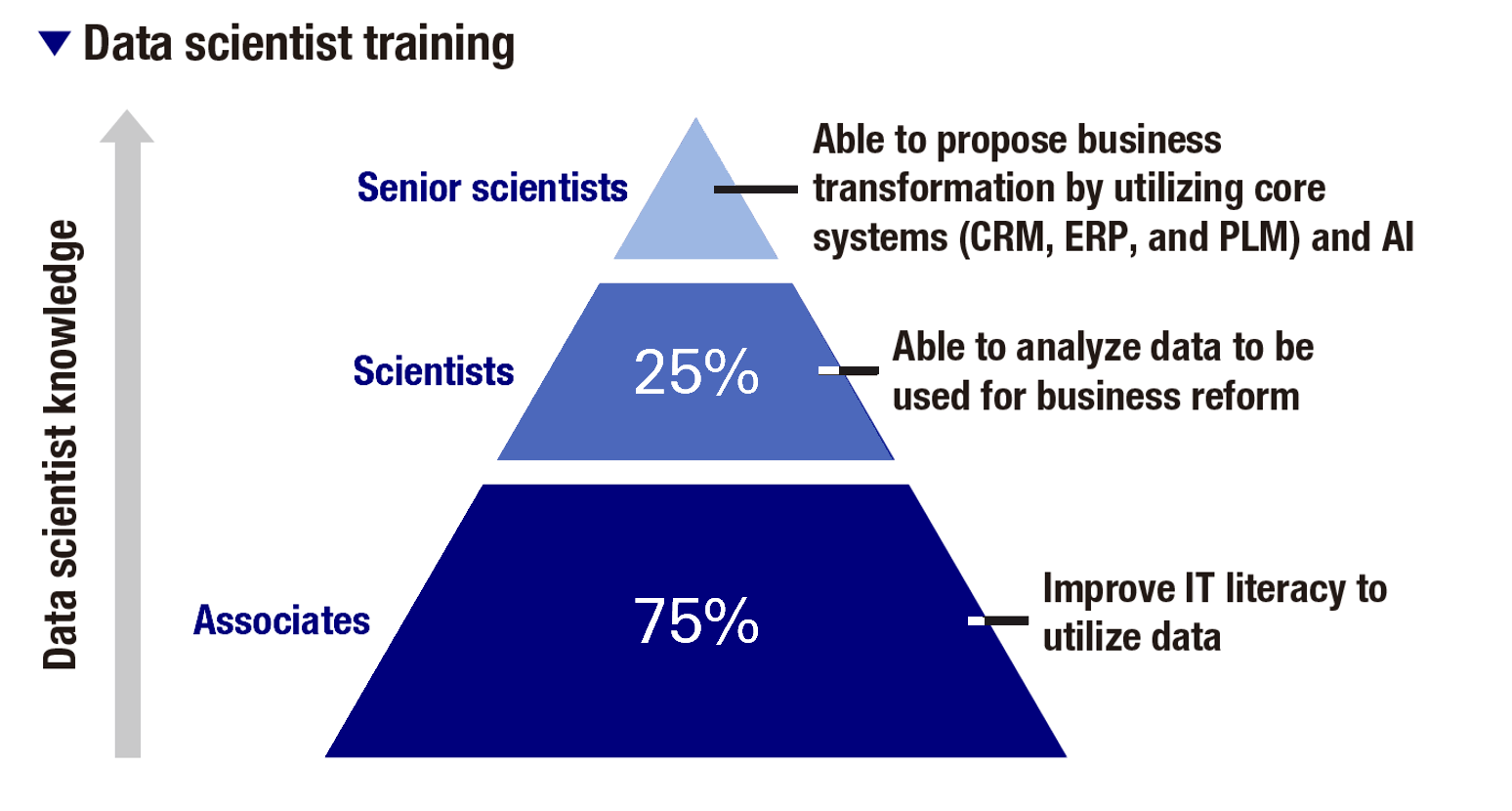
We continuously promote data scientist training and develop human resources who can drive business reform using digital technology.
Data scientist training is available to all divisions, including manufacturing, administration, and sales, in order to strengthen data utilization capabilities and IT literacy as “data scientist associates.”
Additionally, we aim to train 25% of them to become “data scientists,” who will play a pivotal role in championing DX initiatives across the organization. In FY2026, we launched generative AI training programs in Japan and overseas to promote its practical application and adoption in our operations.